If you’re a Chicago Bulls fan, this season’s trade deadline probably felt less like strategy… and more like confusion.
In a span of days, the Bulls front office made a series of moves that left fans, analysts, and even insiders scratching their heads.
Let’s break it down.
They traded Ayo Dosunmu — a homegrown talent and fan favorite — in exchange for rookie Rob Dillingham and future draft picks.
Then, they made another bold move by acquiring Jaden Ivey, a young guard with explosive potential but still developing consistency.
They waived Jevon Carter.
They traded for Ousmane Dieng… only to trade him away the very next day.
Yes. One day.
At first glance, these moves might seem like pieces of a long-term plan.
But the deeper you look, the more questions start to surface.
Because what exactly are the Chicago Bulls trying to build?
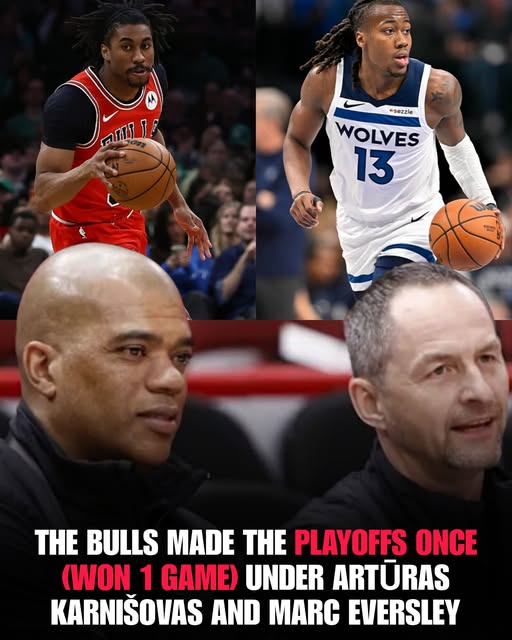
Under the leadership of Artūras Karnišovas and Marc Eversley, the Bulls have struggled to establish a clear identity. Since taking over, the front office has guided the team to the playoffs just once — and even then, they managed to win only a single game.
For a franchise with a legacy as iconic as Chicago’s, that simply isn’t enough.
And now, instead of clarity, fans are seeing what looks like constant reshuffling.
Trading Ayo Dosunmu was particularly emotional. He wasn’t just another player — he represented Chicago. A local product who embodied the city’s grit and pride. Letting him go signals a willingness to move on from familiarity in favor of upside.
But does Rob Dillingham immediately fill that void?
Not likely.
He’s talented, yes. Quick, creative, and full of potential. But he’s also young and unproven at the NBA level. This move suggests the Bulls may be shifting toward a youth-focused rebuild… but if that’s the case, why bring in Jaden Ivey as well?
Ivey is another high-upside guard, but pairing multiple developing players without a clear system can create more problems than solutions.
And then there’s the Ousmane Dieng situation.
Trading for a player and moving him again within 24 hours doesn’t exactly scream long-term vision. Instead, it feels like asset maneuvering — collecting pieces without necessarily knowing how they fit together.
To some, this is smart front-office flexibility.
To others, it’s a sign of uncertainty.
Meanwhile, waiving Jevon Carter removes a veteran presence who could have provided stability in a locker room that now feels increasingly transitional.
So what’s the direction here?
Are the Bulls rebuilding?
Are they retooling around a new core?
Or are they stuck somewhere in between — not bad enough to fully rebuild, but not good enough to contend?
That middle ground is often the worst place to be in the NBA.
Because it leads to exactly what Bulls fans are experiencing right now: frustration.
The Eastern Conference is evolving quickly. Teams are getting younger, faster, and more dynamic. To compete, you need either a clear superstar-led vision or a well-executed rebuild with patience and purpose.
Right now, Chicago seems to have neither.
And that’s the real concern.
Because moves alone don’t define success.
Direction does.
Fans aren’t just reacting to trades — they’re reacting to what those trades represent. A lack of consistency. A lack of identity. And most importantly, a lack of results.
One playoff appearance.
One win.
That’s the reality under this current regime.
And while the new additions may eventually pay off, the question is whether the front office can turn this collection of moves into something meaningful before patience runs out.
Because in Chicago, expectations are always high.
This is a franchise built on championships, legacy, and greatness.
And right now, fans are left wondering if the team is moving forward… or just moving.
So here’s the question Bulls Nation can’t stop asking—
Are these bold, chaotic moves the beginning of a smart rebuild that just hasn’t revealed itself yet… or is this front office simply making it up as they go?
Leave a Reply