⚖️ Boiled Alive: The Horrifying Execution of Richard Roose and the Dark Reality of Tudor Justice
On April 5, 1531, London witnessed a punishment so brutal, so shocking, that it would echo through history as one of the most terrifying displays of justice ever carried out. In the crowded grounds of Smithfield, before a stunned and horrified public, a man named Richard Roose was sentenced to a death unlike any other—he was boiled alive.
This was not just an execution. It was a message.
And it revealed the chilling extremes of justice under King Henry VIII.
🩸 A Crime That Sparked Panic
Richard Roose, also known as Richard Rouse, was a cook employed in the household of Bishop John Fisher, a prominent religious figure and close associate of the English elite. In early 1531, what began as a normal meal quickly turned into a nightmare.
Several people who ate food prepared in Bishop Fisher’s kitchen fell violently ill. Two guests died after consuming what was later believed to be poisoned porridge. Panic spread rapidly—not just among those present, but throughout London’s upper class.
Food, once a symbol of hospitality and trust, suddenly became a source of fear.
Authorities moved quickly. Suspicion fell on Roose, the cook responsible for preparing the meal. Under interrogation—likely involving harsh methods common at the time—he confessed to adding poison to the food. However, his motives remain unclear to this day. Some accounts suggest it may have been intended as a prank gone horribly wrong, while others believe it was deliberate.
Regardless of intent, the consequences would be extreme.
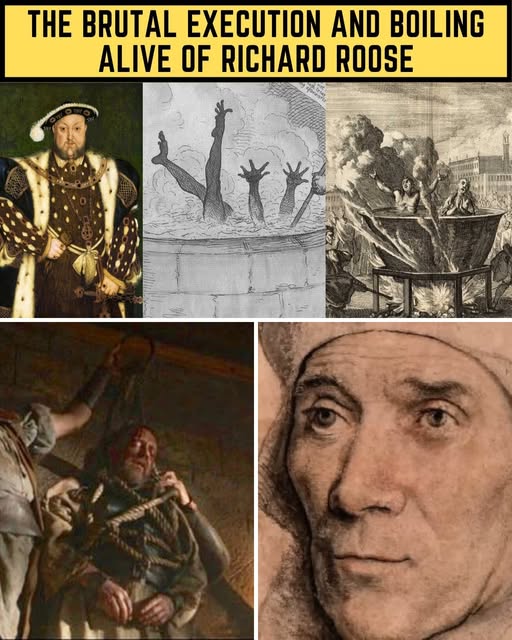
👑 Henry VIII’s Ruthless Response
King Henry VIII, known for his volatile temper and uncompromising rule, was outraged by the incident. Poisoning, particularly in a household of such importance, was seen not only as murder but as an attack on social order itself.
In response, Henry took an unprecedented step.
He ordered that poisoning be classified as high treason—a crime punishable by the most severe methods imaginable. But he didn’t stop there.
A new law was passed specifically for this case, mandating that those convicted of poisoning would be executed by boiling alive.
This was not a traditional method of execution in England. It was designed to be horrifying, unforgettable, and deeply symbolic—a punishment meant to match the perceived cruelty of the crime.
🔥 The Execution at Smithfield
On the day of his execution, Richard Roose was taken to Smithfield, a public space often used for executions and gatherings. A large crowd assembled, drawn by both curiosity and dread.
At the center stood a massive cauldron filled with boiling water.
Roose was lowered into the scalding liquid, where he suffered an agonizing death. Historical accounts describe the horror of the scene—the screams, the smell, the sheer brutality of the act.
It was not a quick death.
It was prolonged. Public. Intended to instill fear.
And it worked.
😨 A City Gripped by Fear
The execution sent shockwaves throughout London.
If poisoning could lead to such a fate, what did that mean for everyone else?
The elite, in particular, became increasingly paranoid about food safety. Meals were scrutinized. Servants were watched more closely. Trust, once assumed in noble households, was replaced by suspicion.
Roose’s execution had achieved its purpose: it terrified the population.
But it also raised uncomfortable questions.
⚖️ Justice or Cruelty?
Even by the standards of the 16th century, Roose’s punishment was considered extreme.
Boiling alive was not only rare—it was widely seen as excessively cruel. The fact that a new law had been created specifically for this case only added to the controversy.
Was this truly justice?
Or was it an example of power being used to make a statement?
Some historians argue that Henry VIII’s decision was driven more by fear and anger than fairness. By elevating poisoning to treason, he ensured that the punishment would be as severe and visible as possible.
Others believe it was a calculated move to maintain control, reinforcing the idea that any threat to the social order would be met with overwhelming force.
📜 A Legacy of Terror
The law allowing boiling as a punishment for poisoning did not last forever. It was later repealed, and such executions were never widely adopted in England.
But the story of Richard Roose endured.
It became a symbol of the darker side of Tudor justice—a reminder that in certain moments, the line between justice and cruelty can blur.
Today, his fate is often cited as one of the most gruesome executions in British history.
🤔 A Question That Still Haunts Us
Nearly 500 years later, the story of Richard Roose still provokes strong reactions.
It forces us to confront uncomfortable truths about power, punishment, and the lengths societies will go to enforce order.
Because while the methods may have changed, the questions remain the same:
When does justice become cruelty—and who gets to decide where that line is drawn?
Leave a Reply