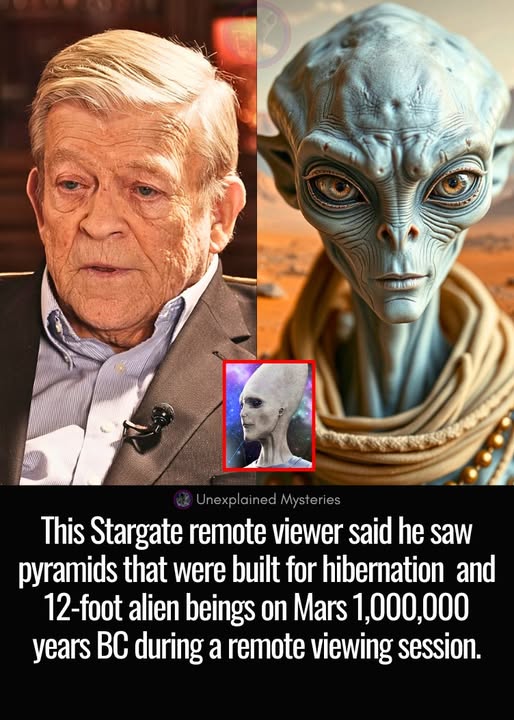
A controversial and highly debated story has resurfaced from the Cold War era, centered around former U.S. Army remote viewer Joe McMoneagle and his alleged 1984 Stargate Program session involving a hidden target on Mars. According to McMoneagle’s own accounts, what he “saw” during controlled remote viewing training was not just abstract imagery—but an entire ancient landscape on Mars filled with pyramids, massive structures, and even possible non-human beings.
His claims, first discussed during his time in the classified Stargate Project and later expanded in interviews, continue to fuel debate between believers in psychic perception and skeptics who argue there is no scientific evidence supporting such interpretations.
The 1984 Stargate Session and the Hidden Mars Target
According to McMoneagle, during a training exercise in 1984, he was given a “blind” target—meaning he was not told what or where it was located. This was standard procedure in the Stargate Project, a program reportedly designed to test the potential of remote viewing for intelligence purposes.
He claims that during this session, he began perceiving a vast Martian environment that included a pyramid-like structure located within a large depression or crater. The terrain, according to his description, appeared yellowish, heavily weathered, and shaped by what he interpreted as catastrophic environmental changes.
As the session continued, McMoneagle reported seeing what he described as smooth walls, large geometric surfaces, and architectural elements that resembled megalithic construction. These features, in his interpretation, suggested a once-advanced civilization rather than natural formations.
The Idea of an Ancient Martian Civilization
One of the most controversial aspects of McMoneagle’s account is his belief that the structures were not isolated but part of a much larger complex.
He described corridors, rooms, and interconnected buildings that appeared to form an extensive ancient city. In his interpretation, this was not a single pyramid, but an entire settlement built on Mars long before any known human presence in the solar system.
Even more striking, he suggested that the structures showed signs of damage or change consistent with a major planetary catastrophe.
In later reflections, McMoneagle expanded on this idea, suggesting that the environment he “observed” may have been the aftermath of a civilization struggling to survive a collapsing atmosphere or global environmental shift.
The “Hibernation Pyramid” Theory
One of the most unusual claims from McMoneagle’s interpretation is the idea that some pyramids may have been used as shelters or hibernation structures.
He described clusters of pyramids that appeared to function as protective environments, possibly designed for survival during extreme atmospheric conditions. In his view, these structures may have been used by inhabitants attempting to “wait out” a planetary crisis.
This led to his theory that Mars may have once hosted intelligent life that constructed these massive structures as part of a survival strategy.
He also referenced a structure he called an “Old Fort,” which he interpreted as a pyramid with its top missing, as well as additional grouped formations and plateau-based complexes.
Beings Described in the Session
Perhaps the most controversial element of McMoneagle’s account is his description of possible beings.
He reported sensing tall, thin figures approximately 12 feet in height, wearing tight-fitting clothing. According to his interpretation during the session, these beings may have been part of the same environment as the structures he observed.
He claimed that when he was instructed to “go back” to an earlier time frame before a catastrophic event, the presence of these beings became more distinct in his perception.
Skeptics argue that such descriptions are highly subjective and could be influenced by imagination, suggestion, or interpretation of abstract mental imagery.
Claims of Scale and Interpretation
McMoneagle also made additional interpretations regarding scale. Based on shadows and perceived geometry in his mental impressions, he suggested that some structures could be extremely large—far larger than typical human architecture on Earth.
He estimated crater walls at thousands of meters in height and pyramid structures of extraordinary size.
However, these measurements are not based on physical observation but on subjective interpretation during remote viewing exercises, which is why they remain highly controversial in scientific communities.
The JPL Connection Claim
One of the most debated parts of McMoneagle’s story involves a later claim that he visited the Jet Propulsion Laboratory (JPL).
In interviews, he stated that he requested photographic negatives of the Mars target areas and that a person at the facility allegedly recognized the imagery as something referred to as “the old city on Mars.”
If true, this would be one of the strongest external confirmations of his experience. However, there is no publicly verified evidence supporting this interaction, and critics argue that such claims are anecdotal and unsubstantiated.
The Stargate Project Context
The broader context of McMoneagle’s story lies within the Stargate Project, a real Cold War-era program conducted by the U.S. government to investigate psychic phenomena for intelligence applications.
While the program did explore remote viewing techniques, it was officially declassified and later concluded with mixed results. Some reports suggested limited success in certain controlled experiments, while others criticized the methodology as lacking scientific rigor.
McMoneagle is one of the most well-known figures associated with the program and has remained a central voice in discussions about remote viewing.
Scientific Skepticism and Ongoing Debate
Mainstream scientists remain skeptical of remote viewing and similar claims, citing a lack of reproducible evidence under controlled conditions.
Critics argue that McMoneagle’s Mars descriptions are likely the result of imagination, subconscious inference, or interpretation of ambiguous mental impressions rather than actual perception of distant locations.
Supporters, however, believe that his detailed descriptions and consistency across sessions warrant further exploration of consciousness and perception.
Final Reflection
Whether viewed as a fascinating glimpse into unexplored human potential or as a compelling but unverified story, the account of Joe McMoneagle continues to capture public imagination decades later.
The idea of ancient pyramids on Mars, possible extraterrestrial beings, and lost civilizations remains one of the most powerful narratives in fringe science discussions.
But as with many extraordinary claims, the key question remains:
Are these visions evidence of hidden truths about Mars—or simply the boundaries of the human mind projecting meaning onto the unknown?
Leave a Reply