In the world of sports, greatness is often measured by dominance, championships, and unforgettable moments—but there’s another rare quality that separates legends from everyone else: longevity. The ability to stay elite for decades is something only a select few athletes in history have achieved. Yet, when it comes to how longevity is perceived, not all legends are treated equally.
Take Jerry Rice and LeBron James, for example.
Both are widely regarded as all-time greats in their respective sports. Both redefined what it means to sustain excellence over time. And yet, the way fans and media talk about their longevity couldn’t be more different.
Jerry Rice is celebrated for it.
LeBron James is often criticized for it.
So why the difference?
The answer lies in narrative, era, and expectations.
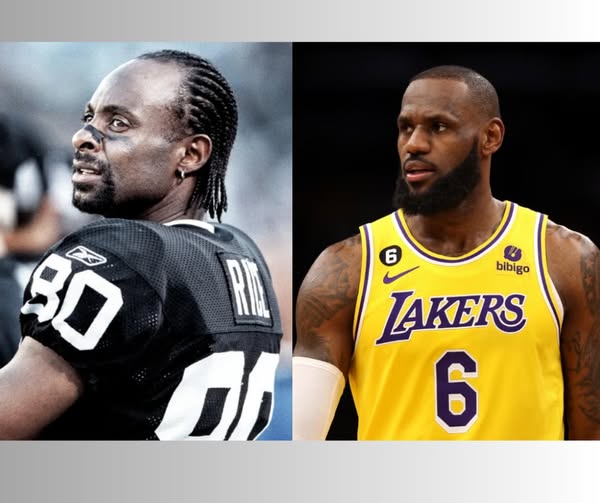
First, consider the context of Rice’s career. Playing in the NFL—arguably one of the most physically demanding leagues in the world—Rice’s longevity was nothing short of extraordinary. The average NFL career is notoriously short, and for wide receivers, maintaining elite performance into their late 30s is almost unheard of. Yet Rice didn’t just last—he thrived.
Even as he aged, he continued to produce at a high level, running precise routes, making clutch plays, and outworking defenders who were often a decade younger. His longevity wasn’t just about surviving—it was about dominating. That’s what made it feel legendary. It wasn’t expected. It wasn’t normal. It was rare.
Because of that, Rice’s career became a symbol of discipline, work ethic, and timeless greatness. Fans didn’t question why he kept playing—they admired it. Every extra season added to his myth.
Now compare that to LeBron James.
From the moment LeBron entered the NBA, he wasn’t just seen as a talented player—he was labeled “The Chosen One.” The expectations placed on him were unlike anything most athletes have ever experienced. He wasn’t just expected to be great—he was expected to be one of the greatest of all time.
And when expectations are that high, perception changes.
LeBron’s longevity isn’t seen as a bonus—it’s treated as part of the standard. Instead of being amazed that he’s still dominating in his late 30s, some critics use it against him. They argue that he’s playing longer to accumulate stats, to chase records, or to strengthen his case in debates against legends like Michael Jordan.
This is where narrative becomes powerful.
For Rice, longevity added to his greatness.
For LeBron, longevity is often dissected, questioned, and sometimes even diminished.
Then there’s the era factor.
LeBron plays in a time where sports science has reached unprecedented levels. Advanced training methods, nutrition plans, recovery technologies, and load management strategies have all contributed to extending athletes’ careers. While these innovations are impressive, they also create skepticism among some fans.
Critics argue that today’s players have advantages that previous generations didn’t, making longevity seem less remarkable. Fair or not, this perception affects how LeBron’s career is viewed.
Rice, on the other hand, played in an era where these advancements were far less developed. His ability to stay at the top without modern recovery tools adds to the “old school” mystique of his legacy. It feels more raw, more difficult, and therefore more admirable in the eyes of many.
But here’s the reality:
Both achievements are extraordinary.
Staying elite in the NFL for as long as Rice did is nearly impossible.
Staying elite in the NBA for as long as LeBron has is just as incredible.
Different sports. Different challenges. Same level of greatness.
The real difference isn’t in what they accomplished—it’s in how people choose to interpret it.
Sports debates are rarely just about facts. They’re shaped by emotion, loyalty, nostalgia, and personal bias. Fans often build narratives that support their beliefs, whether it’s defending a favorite player or elevating a past legend.
And in LeBron’s case, being constantly compared to Michael Jordan has amplified every aspect of his career—including his longevity. Every season he plays becomes another piece of evidence in an ongoing debate, rather than a moment to simply appreciate what he’s doing.
Meanwhile, Rice exists in a space where his greatness feels undisputed, allowing fans to celebrate his longevity without turning it into an argument.
At the end of the day, both athletes have done something incredibly rare.
They didn’t just reach the top—they stayed there.
For years.
For decades.
Through injuries, pressure, and the natural decline that comes with age.
That’s not just talent—that’s discipline, adaptability, and an unmatched level of commitment.
So maybe the conversation shouldn’t be about why one is praised and the other criticized.
Maybe it should be about recognizing that we are witnessing something historic—twice.
Because whether it’s Jerry Rice or LeBron James, greatness like this doesn’t come around often.
And when it does, it deserves to be appreciated—not debated.
Leave a Reply