For generations, the Colorado River has been more than just a body of water—it has been the lifeblood of the American Southwest. Carving through canyons, powering cities, and sustaining millions of lives, it once stood as a symbol of strength and abundance. Today, that symbol is fading.
The Colorado River is in crisis.
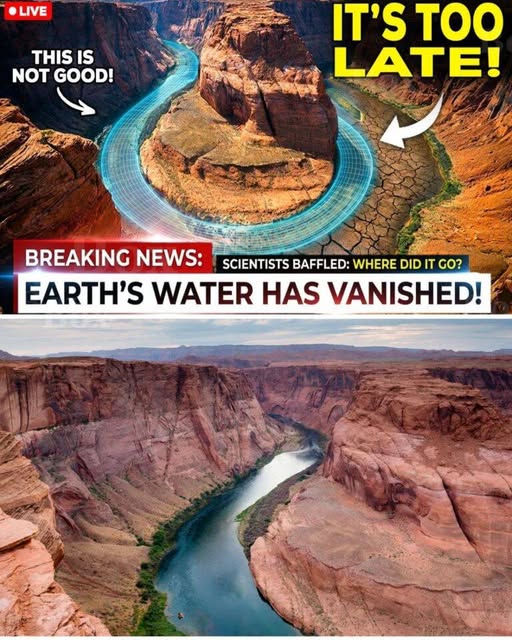
Key stretches of the river are no longer flowing. Reservoirs that once brimmed with water are shrinking to historic lows. Lake Mead and Lake Powell—two of the largest and most critical reservoirs in the United States—are now exposing vast stretches of dry, cracked earth where water once stood. Boat docks sit stranded, ecosystems are collapsing, and entire communities are beginning to confront a reality that once seemed unthinkable: a future without reliable water.
Nearly 40 million people depend on the Colorado River.
From major cities like Las Vegas, Phoenix, and Los Angeles to agricultural regions that feed much of the country, the river has quietly supported life on a massive scale. But that support system is beginning to fail—and the consequences could reshape the region forever.
What’s happening isn’t just a drought.
For years, many hoped that lower water levels were temporary, part of a natural cycle that would eventually correct itself. But scientists are now sounding a much more alarming warning: this is a long-term structural collapse. Rising temperatures, driven by climate change, are accelerating evaporation and reducing snowpack in the Rocky Mountains—the river’s primary source. Less snow means less water flowing downstream.
At the same time, demand hasn’t slowed.
Decades of overuse have pushed the river beyond its limits. Water rights agreements, created during wetter periods in the early 20th century, allocated more water than the river can now provide. As populations have grown and agriculture has expanded, the pressure has only intensified.
The result is a system stretched to the breaking point.
Lake Mead, in particular, has become a symbol of this crisis. Its water levels have dropped so low that officials have had to implement emergency measures to prevent the reservoir from falling below critical thresholds. If levels drop too far, it could threaten hydropower generation at Hoover Dam and disrupt water deliveries to millions.
But the crisis doesn’t stop at the surface.
Groundwater—often seen as a backup during shortages—is being drained faster than it can be replenished. Aquifers that took thousands of years to fill are now being depleted in decades. Wetlands are disappearing, wildlife habitats are shrinking, and the ecological balance of the region is being disrupted.
This is not just an environmental issue—it’s a human one.
Farmers are already feeling the impact. With less water available for irrigation, crop yields are declining, and food prices could rise as a result. Cities are being forced to consider strict water restrictions, infrastructure changes, and even the possibility of long-term shortages.
And yet, despite the urgency, solutions are complex.
Reducing water use means difficult trade-offs—between urban growth and conservation, between agriculture and sustainability, between short-term needs and long-term survival. States that rely on the river must negotiate new agreements, often under intense political and economic pressure.
There is no easy fix.
Some efforts are already underway. Conservation programs, water recycling initiatives, and new technologies are being explored to stretch existing supplies further. But many experts warn that these measures may not be enough without significant, coordinated action across the region.
The reality is becoming harder to ignore.
The Colorado River, once powerful enough to carve the Grand Canyon, is now struggling to sustain the systems built around it. What was once taken for granted is now uncertain. What once seemed endless is now clearly finite.
And perhaps the most unsettling part is this:
This may be the new normal.
As climate patterns continue to shift and demand remains high, the question is no longer about when the river will recover. It’s about how communities will adapt if it doesn’t.
How do cities survive with less water?
How do farmers continue to grow food?
How do ecosystems endure in a landscape that is drying out?
These are not distant concerns—they are challenges unfolding right now.
The Colorado River is not just a river. It is a warning.
A warning about limits.
A warning about sustainability.
A warning about what happens when demand outpaces nature.
And as the water continues to recede, one question becomes impossible to ignore:
If the Colorado River can no longer support the Southwest, what does the future of millions of lives in this region truly look like?
Leave a Reply