Some moments in a person’s early life quietly foreshadow the values they will carry for decades. For Senator Bernie Sanders, one such moment took place in 1963, when he was just 21 years old. According to reporting by the Chicago Tribune, Sanders was arrested by Chicago police while participating in a protest against school segregation—a decision that would later stand as one of the earliest public markers of his long-standing commitment to civil rights and social justice.
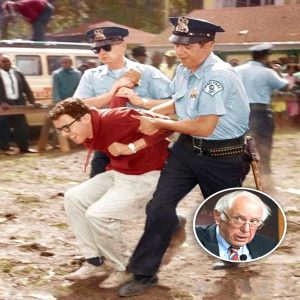
At the time, Chicago’s public school system was embroiled in fierce controversy over segregation practices. Despite legal advances at the federal level, many cities continued to operate systems that effectively separated students by race. One of the most visible symbols of this practice in Chicago was the use of so-called “Willis Wagons,” mobile classroom units named after school superintendent Benjamin Willis. These temporary structures were placed near predominantly Black schools, even when nearby white schools had available classroom space.
Critics argued that the Willis Wagons were not a practical solution to overcrowding, but a deliberate strategy to maintain racial separation. For Black parents and students, they represented exclusion, inequality, and a refusal to provide equal educational opportunities. It was against this backdrop that Sanders joined hundreds of Black parents, students, and civil rights activists to protest the policy.
The demonstration was peaceful but determined. Protesters demanded fair access to schools, equal treatment under the law, and an end to policies that reinforced segregation. Sanders, then a college student, stood in solidarity with those directly affected, lending his voice and presence to a movement led by the Black community itself.
During the protest, Sanders was arrested and charged with resisting arrest. He was later found guilty and fined $25—a modest sum even at the time, but one that carried symbolic weight. The arrest placed Sanders on the record, not as an observer of the civil rights struggle, but as a participant willing to face legal consequences for his beliefs.
More than sixty years later, that moment continues to resonate. As Sanders has risen from local activism to national prominence as a U.S. senator and presidential candidate, supporters and critics alike often point to his 1963 arrest as evidence of ideological consistency. Unlike many political figures whose positions evolve dramatically over time, Sanders’ early actions closely align with the principles he still emphasizes today: equality, fairness, and opposition to systems that disadvantage marginalized communities.
Supporters argue that this consistency is rare in American politics. They note that Sanders’ advocacy for civil rights did not begin when it became politically advantageous, but at a time when participation in such protests carried real personal risk. In the early 1960s, civil rights activists frequently faced arrest, violence, and social backlash, particularly those who challenged segregation in Northern cities that often denied having a racial problem at all.
Critics, while acknowledging the historical fact of the arrest, caution against using a single event to define an entire political career. They argue that voters should focus on current policies, legislative records, and practical outcomes rather than symbolic moments from decades past. Still, even many critics concede that Sanders’ early involvement in civil rights activism distinguishes him from some contemporaries whose engagement came later.
Historians note that the Chicago school protests were a significant chapter in the broader civil rights movement. While Southern segregation often dominates public memory, Northern cities like Chicago faced deep structural inequalities that were harder to dismantle because they were less explicitly codified in law. The fight against the Willis Wagons highlighted how segregation could persist through administrative decisions rather than overt statutes.
Sanders’ participation placed him within a larger coalition of students, parents, and activists who believed that education was a fundamental right. The protest was not just about classrooms, but about dignity and opportunity—values that would later become central themes in Sanders’ political rhetoric.
Over the years, Sanders has frequently referenced his early activism when discussing his political philosophy. He has described civil rights, economic justice, and equality as interconnected struggles, arguing that access to quality education is inseparable from broader issues of poverty and discrimination. For his supporters, the 1963 arrest serves as tangible proof that these beliefs were not adopted later for political gain.
The story has also gained renewed attention in recent years as voters increasingly scrutinize the authenticity of political leaders. In an era of rapid news cycles and shifting positions, past actions are often revisited as a way to assess credibility. Sanders’ arrest record, documented by contemporary reporting rather than retrospective claims, stands as a rare piece of verifiable history.
For many Americans, the significance of the moment transcends party politics. Even those who disagree with Sanders on policy often acknowledge that standing against segregation at 21 years old reflects moral clarity. It illustrates a willingness to challenge injustice not from a position of power, but from conviction.
As debates over education equity, racial justice, and civil rights continue today, the events of 1963 feel far from distant. School segregation, while less overt, remains a concern in many communities. In that sense, Sanders’ early protest is not just a historical footnote, but part of an ongoing conversation about fairness and opportunity in American life.
Ultimately, the image of a young Bernie Sanders being led away in handcuffs during a civil rights protest endures because it aligns so closely with the man he would become. Whether admired or criticized, his political identity has remained remarkably consistent. And for many, that consistency—rooted in a moment of quiet courage more than six decades ago—continues to shape how his legacy is understood today.
Leave a Reply