A silent pressure is building beneath our feet—and scientists say it’s only a matter of time before it’s released.
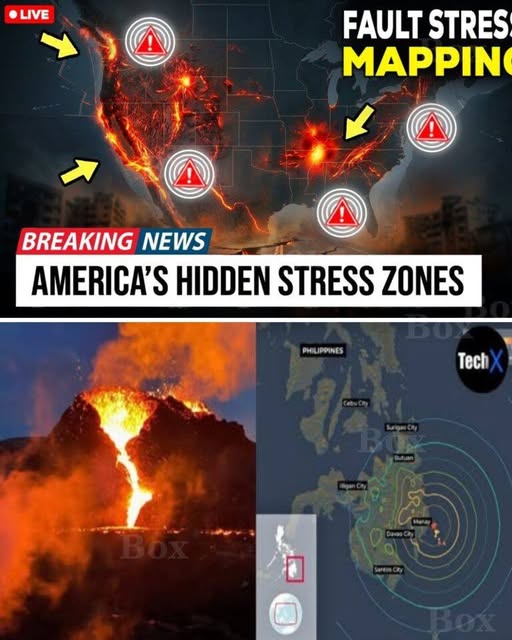
Across the United States, new research is raising alarms about increasing seismic stress along major fault lines. From California’s infamous San Andreas Fault to lesser-known but equally dangerous zones in the Midwest and Pacific Northwest, experts are warning that the risk of a major earthquake is no longer hypothetical. It’s inevitable.
“It’s not if, but when.”
That phrase, repeated by geologists and researchers, carries a chilling certainty. Unlike storms or hurricanes, earthquakes don’t come with clear warnings. There are no satellite images showing their approach, no countdown clocks ticking down. When they strike, they do so suddenly—and often with devastating consequences.
So what exactly is happening beneath the surface?
The Earth’s crust is made up of massive tectonic plates that are constantly moving, albeit slowly. Where these plates meet, stress builds over time. Fault lines—cracks in the Earth’s crust—are the points where this energy is eventually released. The longer the stress accumulates, the more powerful the eventual rupture can be.
Recent studies suggest that several of these fault lines across the U.S. are reaching critical levels of stress.
The San Andreas Fault in California has long been considered one of the most dangerous in the world. Scientists have been monitoring it for decades, anticipating what many refer to as “The Big One”—a massive earthquake that could cause widespread destruction across major cities like Los Angeles and San Francisco. But it’s not the only concern.
In the Pacific Northwest, the Cascadia Subduction Zone poses a different kind of threat. This fault line has the potential to produce a megathrust earthquake—one so powerful it could trigger massive tsunamis and reshape entire coastlines. Historical evidence shows that such events have occurred before, roughly every 300 to 500 years. The last one struck in 1700.
Which means the clock is ticking.
Meanwhile, in the central United States, the New Madrid Seismic Zone has surprised scientists with its potential for significant earthquakes. Though less active in recent years, it was responsible for some of the strongest quakes in U.S. history in the early 1800s. Today, researchers are finding signs that stress is once again building in the region.
What makes this situation particularly concerning is not just the science—but the unpredictability.
Despite advances in technology, accurately predicting earthquakes remains one of the greatest challenges in modern science. Early warning systems can provide seconds—or at best, minutes—of notice once an earthquake has already begun. But predicting exactly when and where one will strike? That’s still beyond our reach.
And that uncertainty is what makes preparedness so critical.
Millions of Americans live in areas that could be affected by major earthquakes. Yet many remain unprepared. Buildings, especially older ones, may not be designed to withstand strong shaking. Emergency plans are often overlooked. Supplies that could mean the difference between survival and disaster are missing.
Experts emphasize that while we cannot stop earthquakes, we can reduce their impact.
Strengthening infrastructure, enforcing stricter building codes, and educating communities are key steps. Individuals can also take action—securing heavy furniture, preparing emergency kits, and knowing what to do during an earthquake can save lives.
But beyond preparation, there’s a deeper question: why is this happening now?
Some researchers believe that natural cycles of tectonic activity are at play, while others are exploring whether human activities—such as drilling or groundwater extraction—may influence seismic stress in certain regions. While the exact causes vary, the consensus remains clear: the risk is increasing.
And yet, despite the warnings, the topic often fades from public attention.
Earthquakes are easy to ignore—until they happen.
Unlike visible threats, seismic stress builds quietly, invisibly, beneath the surface. There are no daily reminders, no immediate signs of danger. Life continues as normal… until it doesn’t.
History has shown us what’s possible. From the devastating 1906 San Francisco earthquake to more recent events around the world, the impact of major seismic activity can be catastrophic. Lives are lost. Cities are changed. Recovery can take years—sometimes decades.
The question is not whether the United States will face another major earthquake.
It will.
The real question is whether we will be ready when it happens.
Because when the ground begins to shake, there won’t be time to debate, to prepare, or to react slowly.
Only time to survive.
Leave a Reply