For 65 years, the Dyatlov Pass incident has haunted the world—but what if the truth is far more terrifying than any conspiracy?
In 1959, nine experienced hikers ventured into the Ural Mountains of the Soviet Union and never returned. What rescuers found weeks later would become one of the most baffling mysteries in modern history: a tent cut open from the inside, bodies scattered across the snow, many of them half-dressed despite the brutal cold, and injuries that made no immediate sense.
For decades, theories exploded across the globe.
Aliens. Secret military experiments. Paranormal forces. Each explanation tried to fill the gaps left by the strange and incomplete evidence. Why would trained hikers abandon their shelter in the middle of the night? Why run barefoot into subzero temperatures? Why did some bodies show signs of severe trauma without external wounds?
Now, a new wave of analysis—powered by artificial intelligence and modern simulation models—may be offering a far simpler, yet more chilling answer.
Instead of mystery, it points to a deadly combination of natural forces and human reaction under extreme stress. No cover-ups. No supernatural forces. Just one catastrophic moment that spiraled out of control in minutes.
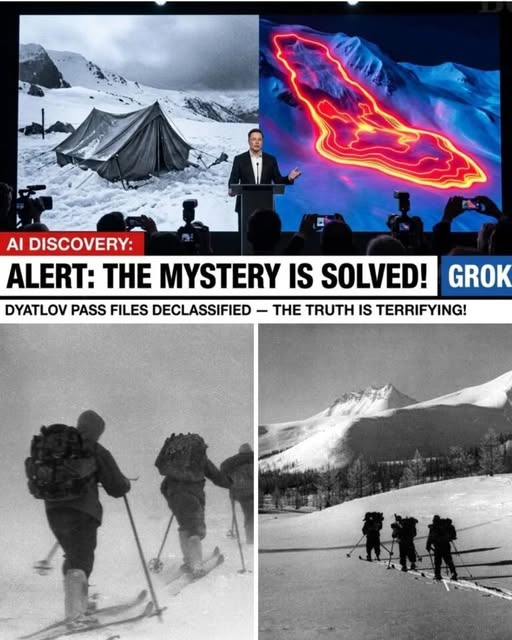
At the center of this theory is a phenomenon known as a slab avalanche.
Unlike massive, obvious avalanches that sweep down mountains with unstoppable force, slab avalanches can be small, sudden, and deceptively silent. A layer of snow breaks loose and slides, creating enough pressure and danger to force immediate escape—but not always enough to leave obvious large-scale destruction.
According to AI-backed reconstructions, this may have been exactly what happened.
The hikers had pitched their tent on a slope—a decision that, under normal circumstances, might have been safe. But beneath them, layers of snow were unstable. Over time, pressure built up. Then, in the middle of the night, something shifted.
The snow cracked.
The slope gave way.
And in that moment, everything changed.
The hikers, suddenly aware of the danger, had seconds to react.
Faced with the possibility of being buried alive, they cut their way out of the tent from the inside—faster than trying to exit normally. There was no time to grab proper clothing. No time to organize. Just instinct.
Run.
And they did.
Into the freezing darkness.
But escaping the immediate danger was only the beginning of the tragedy.
Temperatures that night dropped to around -30°C (-22°F). Without proper gear, survival time was brutally short. Some of the hikers attempted to build a fire. Others tried to return to the tent. A few sought shelter near the forest.
But in those conditions, even small mistakes become fatal.
Hypothermia set in quickly.
As the body loses heat, judgment fades. Victims may become confused, irrational—even removing their own clothing in a paradoxical reaction known as “paradoxical undressing.” This could explain why some of the hikers were found partially dressed despite the extreme cold.
The more severe injuries found on some bodies—fractured ribs, skull damage—may have come later.
AI simulations suggest that after fleeing, some hikers fell into a ravine hidden beneath the snow. The impact, combined with the weight of snow collapsing around them, could produce injuries similar to those seen in high-speed accidents—without external wounds.
No mystery weapons.
No hidden enemies.
Just nature, unforgiving and absolute.
What makes this explanation so unsettling is its simplicity.
There was no grand event. No dramatic explosion. No visible catastrophe. Just a series of small decisions—where to camp, how to respond—that, when combined with the environment, led to disaster.
And it all unfolded in minutes.
The Dyatlov Pass incident may not be a story of the unknown after all.
It may be a story of how quickly control can vanish in extreme conditions. How even experienced individuals can be overwhelmed when nature shifts unexpectedly. And how survival can depend on seconds—and choices made under pressure.
Yet, even with this new explanation, the case continues to captivate the world.
Because while science can reconstruct the “how,” the human element—the fear, the confusion, the final moments—remains impossible to fully understand.
Nine people stepped into the wilderness that night, confident and prepared.
Within hours, everything was gone.
And now, decades later, we may finally be closer to the truth.
But that truth raises an even more unsettling thought:
If it could happen to them—could it happen to anyone?
Leave a Reply