Trump Shares AI Deepfake Targeting Hakeem Jeffries Amid U.S. Government Shutdown Tensions
Washington, D.C. — Just hours before a partial U.S. government shutdown, former President Donald Trump escalated political tensions by posting an AI-generated deepfake video targeting House Minority Leader Hakeem Jeffries. The latest move highlights the deepening divide between the two major parties as budget negotiations falter.
On September 30, Trump shared the video on his social media platform Truth Social. The clip portrayed Jeffries and Senate Minority Leader Chuck Schumer outside the White House, but with exaggerated alterations: Jeffries was depicted wearing a sombrero and sporting a fake mustache, accompanied by mariachi music playing in the background. The video was an apparent attempt to ridicule the Democratic leaders at a time of heightened political friction.
Jeffries swiftly condemned the video, calling it a “racist” and “disgusting” attack. In an interview with MSNBC, he described the clip as “an offensive attempt to demean political opponents and distract from serious legislative responsibilities.” He emphasized that such antics undermine the work of Congress at a time when Americans rely on their government to function effectively.
The incident came as federal lawmakers struggled to finalize a spending deal. The looming partial government shutdown, set to begin on October 1, intensified the stakes for both parties. Budget negotiations remained deadlocked, with Democrats and Republicans refusing to compromise on key priorities, including federal spending allocations, social program funding, and debt limits.
A Pattern of Digital Attacks
This is not the first time Trump has used AI-generated content to attack political opponents. Earlier in the week, he shared a separate video featuring Jeffries during a MSNBC interview in which he criticized the original deepfake. Trump then overlaid additional AI imagery, adding the sombrero and mustache to Jeffries, and inserted four images of himself playing mariachi music while Jeffries spoke. The videos were designed to mock Jeffries publicly and amplify partisan messaging ahead of critical votes.
Trump also posted photographs from a White House meeting earlier that week with Jeffries, Schumer, Senate Majority Leader John Thune, and House Speaker Mike Johnson. Some images depicted the four congressional leaders in conversation, while another showed Trump pointing at Jeffries with a mocking expression. In all, Trump emphasized his political brand by placing a “Trump 2028” hat on the desk in the Oval Office, signaling his ongoing influence and future ambitions.
Jeffries Responds to Escalation
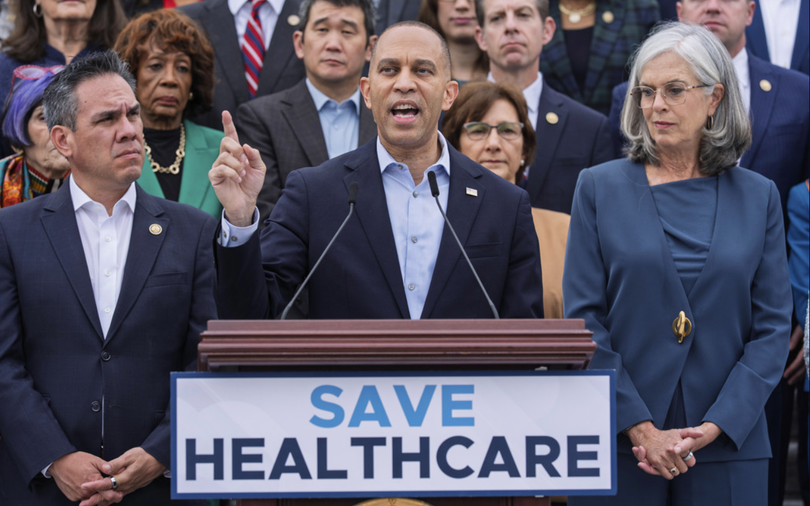
At a House Democratic press conference on Tuesday, Jeffries challenged Trump to engage directly rather than resorting to digital mockery. “If the former president has serious concerns, he should address them openly, not through manipulated videos,” Jeffries said.
In subsequent comments on MSNBC, Jeffries sought to de-escalate while maintaining a firm critique. “We need a president focused on his responsibilities, rather than creating racially charged or malicious content to distract from the work of Congress,” he said. “These antics make it harder for Democrats to deliver results for the American people, and they undermine trust in our institutions.”
Political analysts note that Trump’s use of deepfake technology reflects a broader trend in digital campaigning and political warfare. “This is a new era where AI-generated content can be used to humiliate opponents and sway public opinion instantly,” said Dr. Karen Liu, a political communications expert at Georgetown University. “It raises serious questions about ethics, misinformation, and the boundaries of political discourse.”
Context: Budget Deadlock and Government Shutdown
The video appeared against the backdrop of the U.S. federal government’s looming partial shutdown. Congress had been negotiating a budget to fund federal agencies and prevent a shutdown. However, persistent partisan divides and disagreements over spending priorities, including defense funding, social programs, and tax measures, left lawmakers at an impasse.
The partial shutdown officially began on October 1, affecting thousands of federal employees and disrupting government services. Democrats and Republicans blamed each other for the deadlock, with Trump’s provocative posts adding another layer of political tension.
Jeffries and other Democratic leaders have warned that such tactics distract from pressing issues, including funding for essential services, public safety programs, and social welfare initiatives. “At a time when government operations are being threatened, it is unacceptable to focus on mockery rather than solutions,” Jeffries said.
Implications of AI in Political Attacks
The incident raises broader concerns about the role of AI in political communication. Deepfake technology allows individuals to create highly realistic—but false or misleading—videos that can influence public perception or intimidate opponents. Experts warn that misuse of such technology could erode trust in public figures, distort political debates, and increase polarization.
“The proliferation of AI deepfakes in politics is a serious challenge for democracy,” said Liu. “Voters must critically evaluate what they see online, and lawmakers must consider regulatory or ethical guidelines to prevent abuse.”
Trump’s decision to post multiple videos, including overlays and digital additions to Jeffries’s original interview, demonstrates how AI can be used repeatedly to reinforce a political narrative. For Jeffries, this has meant addressing both the content of the videos and the broader political and ethical implications in real time.
National and Political Reactions
Reactions from politicians and the public have been mixed. Democrats condemned the deepfake as a racially insensitive attack and an irresponsible use of technology. Republican reactions have been more divided, with some dismissing the videos as harmless satire, while others caution that such tactics could backfire politically.
Social media users also expressed concern about the ethical implications of AI manipulation. Critics argue that spreading deepfake content undermines civil discourse and risks inflaming political and racial tensions. Meanwhile, supporters of Trump claimed the videos were humorous and part of standard political banter, though the debate underscores the challenges AI poses in modern campaigning.
Looking Ahead
As the government continues to navigate the partial shutdown, tensions between Trump and Democratic leaders like Jeffries are expected to remain high. Jeffries has emphasized the need for constructive engagement and substantive debate, warning that distractions such as deepfake attacks divert attention from pressing legislative responsibilities.
The events surrounding the deepfake and the shutdown highlight the increasingly complex intersection of politics, technology, and media. How elected officials respond to such challenges may shape public trust, legislative effectiveness, and the broader political climate in the United States.
For now, Jeffries and other Democratic leaders continue to push for focus on governance and accountability, while Trump’s social media activity demonstrates the ongoing evolution of political strategy in the digital age.
See details below 👇👇
Leave a Reply